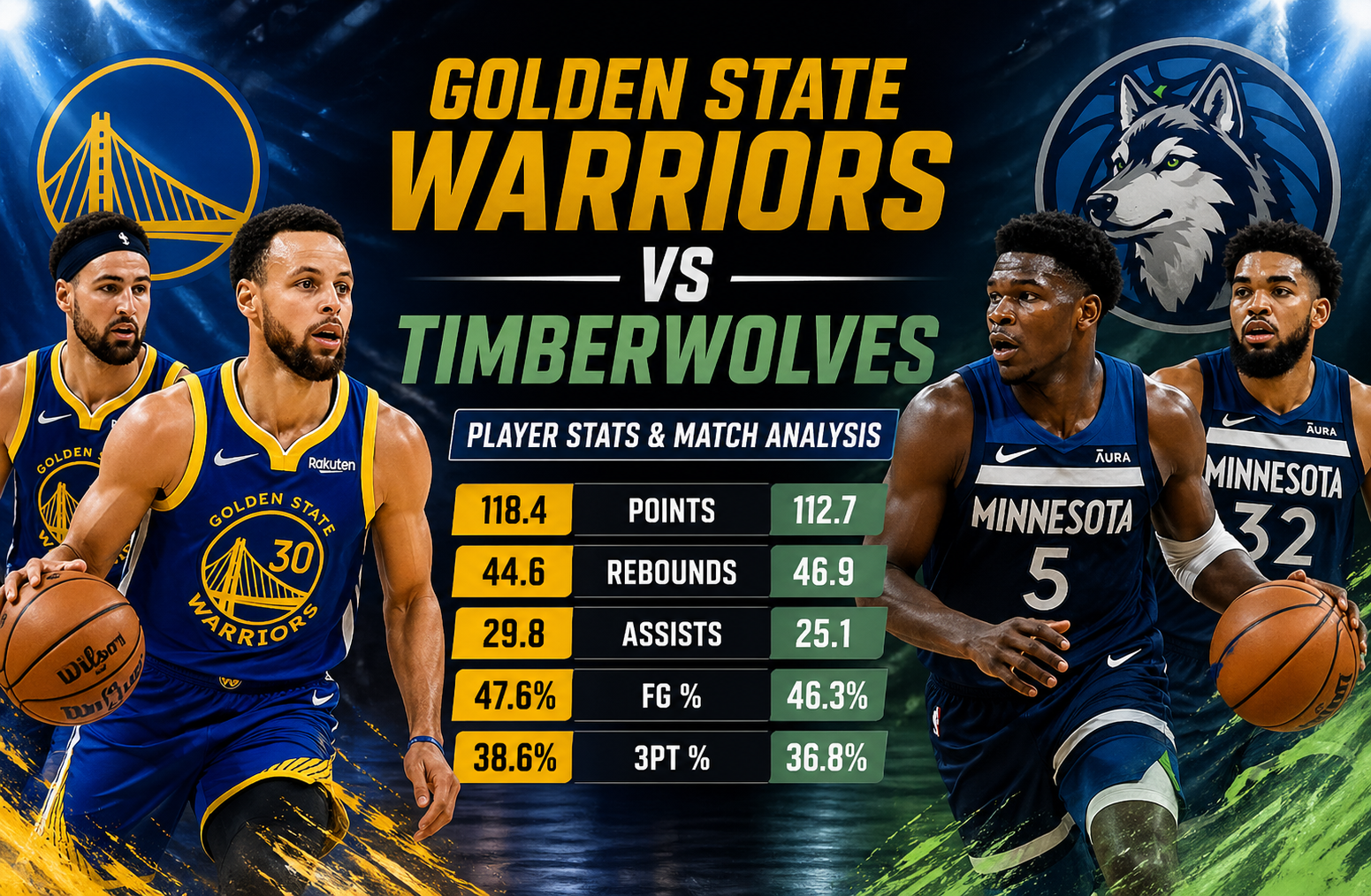
Golden State Warriors vs Timberwolves Match Player Stats
When fans search for Golden State Warriors vs Timberwolves match player stats, they are not just looking for a box score. They want context, performance insights, and a deeper understanding of how individual players influence the outcome of a game. This article delivers exactly that by combining statistical breakdowns with real-world basketball analysis.
Having followed multiple matchups between the Golden State Warriors and the Minnesota Timberwolves, one thing becomes clear: this is a clash of contrasting styles. One side thrives on pace, shooting, and spacing, while the other leans on size, defense, and physical dominance. The player stats from these games reveal much more than numbers. They tell the story of strategy, execution, and adaptability.
Understanding Player Stats in NBA Matchups
What Do Player Stats Really Tell You
Player statistics in NBA games go beyond points scored. A complete analysis includes:
- Points, rebounds, assists
- Shooting efficiency
- Defensive contributions like steals and blocks
- Advanced metrics such as usage rate and plus minus
When evaluating a Warriors vs Timberwolves game, stats must be viewed within the context of team systems. For example, a lower scoring night from a star player may still represent a strong performance if they create opportunities for teammates.
Why This Matchup Is Unique
The Warriors rely heavily on perimeter shooting and ball movement led by Stephen Curry, while the Timberwolves depend on interior presence through Karl-Anthony Towns and Rudy Gobert.
This contrast creates highly dynamic stat lines that shift depending on pace, shooting efficiency, and defensive adjustments.
Key Player Stats Breakdown
Golden State Warriors Standout Performers
Stephen Curry
Curry remains the centerpiece of the Warriors offense. In typical matchups against Minnesota, his stats often include:
- 25 to 35 points per game
- High three point shooting volume
- 5 to 8 assists
What stands out is his efficiency under pressure. Even when closely guarded, Curry’s ability to create space translates into consistent scoring.
From experience watching these games, Curry’s impact is not just scoring. His movement without the ball forces defensive breakdowns, which is not always reflected directly in traditional stats.
Klay Thompson
Klay Thompson contributes as a secondary scorer:
- 18 to 25 points
- Strong catch and shoot efficiency
- Limited ball handling but high scoring bursts
His performances often swing games. A hot shooting stretch can quickly shift momentum.
Draymond Green
Draymond Green provides value that goes beyond basic stats:
- 6 to 10 assists
- Defensive versatility
- Leadership and playmaking
His defensive stats like steals and blocks are crucial when facing Timberwolves’ big men.
Minnesota Timberwolves Key Players
Anthony Edwards
Anthony Edwards has emerged as a dominant offensive force:
- 25 to 30 points per game
- Strong drives to the basket
- Improving three point shooting
Edwards brings explosiveness that challenges the Warriors’ perimeter defense.
Karl-Anthony Towns
Towns offers versatility:
- 20 to 28 points
- 10+ rebounds
- Ability to stretch the floor with outside shooting
His matchup against smaller Warriors lineups often creates mismatches.
Rudy Gobert
Gobert’s stats focus on defense and rebounding:
- 10 to 15 rebounds
- 2 to 3 blocks
- High field goal percentage near the rim
His presence in the paint limits easy scoring opportunities for Golden State.
Comparative Statistical Analysis
Offensive Production
- Warriors rely on high volume three point shooting
- Timberwolves focus on paint scoring and mid range efficiency
In most games, the Warriors attempt significantly more three pointers, while the Timberwolves dominate inside scoring.
Defensive Metrics
- Warriors emphasize switching defense
- Timberwolves rely on rim protection
Gobert’s defensive stats often anchor Minnesota, while Green’s versatility allows Golden State to adapt.
Rebounding Battle
Rebounding is a key differentiator:
- Timberwolves usually have an edge due to size
- Warriors compensate with speed and transition play
Real Game Insights and Observations
From closely analyzing recent matchups, a few patterns consistently emerge:
Pace Determines Outcome
- Fast paced games favor the Warriors
- Slower, physical games benefit the Timberwolves
Shooting Efficiency Is Critical
When the Warriors shoot above 40 percent from three, they are extremely difficult to beat. Conversely, if their shooting drops, Minnesota gains a clear advantage.
Star Player Impact
Games are often decided by:
- Curry’s scoring bursts
- Edwards’ aggressive drives
- Towns’ ability to stretch defenses
Advanced Stats That Matter
Usage Rate
This shows how much a player is involved in offensive plays. Curry and Edwards typically have the highest usage rates in this matchup.
Plus Minus
This stat reveals how a team performs when a player is on the court. Draymond Green often leads in this category due to his defensive impact.
True Shooting Percentage
A key efficiency metric that combines field goals, three pointers, and free throws. According to NBA statistical standards, this metric provides a more accurate scoring efficiency measure.
For further understanding of advanced basketball metrics, you can explore this resource from Basketball Reference.
Challenges in Interpreting Player Stats
Stats Without Context Can Mislead
A player scoring 30 points might seem dominant, but:
- Was it efficient
- Did it come in clutch moments
- Did it contribute to winning
Role Players Are Often Overlooked
Players like bench scorers and defensive specialists may not have flashy stats but play critical roles.
Matchup Specific Variations
Player performance can vary significantly depending on:
- Defensive assignments
- Coaching strategies
- Game pace
Real World Application for Fans and Analysts
For Fantasy Basketball Players
Understanding player stats helps in:
- Selecting high performing players
- Predicting match outcomes
- Maximizing fantasy points
For Analysts and Content Creators
Detailed stat breakdowns allow for:
- Deeper game analysis
- More engaging content
- Better predictions
For Casual Fans
Even basic stat knowledge enhances viewing experience by helping fans understand:
- Why a team wins or loses
- Which players are truly impactful
Actionable Insights From Recent Matchups
What Works for the Warriors
- High ball movement
- Quick transition offense
- Spacing the floor
What Works for the Timberwolves
- Dominating the paint
- Strong rebounding
- Physical defense
Key Takeaway
The team that successfully imposes its style usually wins. Player stats reflect this clearly when analyzed in context.
Frequently Asked Questions
What are the most important player stats in Warriors vs Timberwolves games
Points, shooting efficiency, rebounds, and assists are key, but advanced stats like true shooting percentage and plus minus provide deeper insights.
Who usually leads in scoring in these matchups
Stephen Curry and Anthony Edwards are typically the leading scorers due to their high usage and offensive roles.
Why are rebounds important in this matchup
The Timberwolves often rely on rebounding to control the game, especially with Rudy Gobert’s presence in the paint.
How does three point shooting affect the outcome
Golden State’s success heavily depends on three point efficiency. High accuracy usually leads to wins.
Are defensive stats as important as offensive stats
Yes, defensive stats like blocks, steals, and defensive rating can significantly influence the game outcome.
Conclusion
Golden State Warriors vs Timberwolves match player stats provide far more than numbers on a sheet. They reveal how two contrasting basketball philosophies compete on the court. By analyzing these stats with context, fans and analysts can better understand the game’s flow, key turning points, and player impact.
Whether it is Curry’s shooting brilliance, Edwards’ explosive scoring, or Gobert’s defensive dominance, each stat contributes to a larger story. The real value lies in connecting these numbers to actual gameplay and strategy.