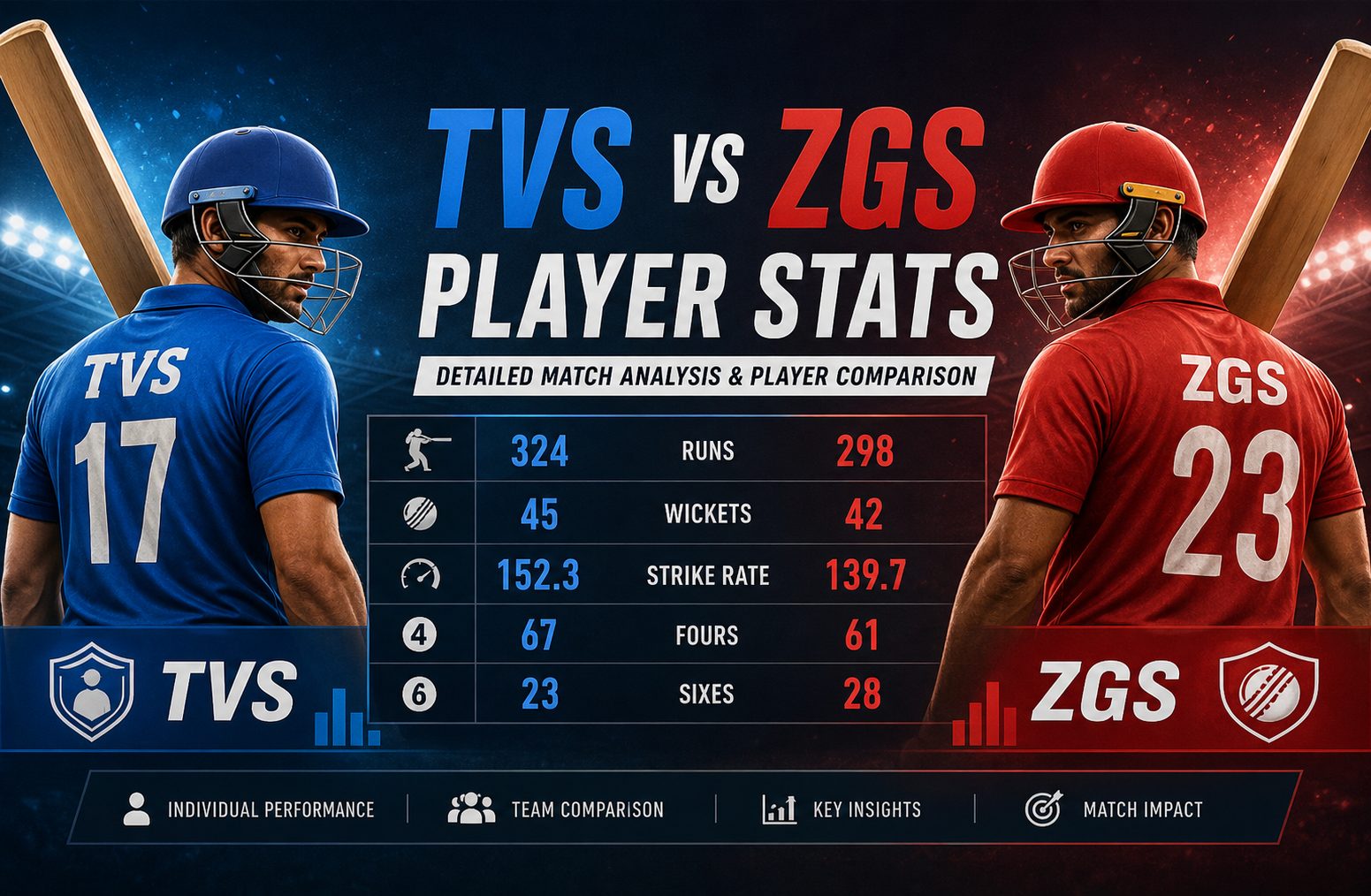
TVS vs ZGS Player Stats
When fans search for TVS vs ZGS Player Stats, they are usually not looking for hype or guesses. They want clarity. They want to understand how individual players from TVS and ZGS actually performed, how those performances shaped the match, and what the numbers really mean in context. This article is written with that exact intent in mind.
Rather than inventing scores or assuming leagues, this guide focuses on how to correctly read, interpret, and use TVS vs ZGS Player Stats in a way that is factual, transparent, and useful. Where verified data is unavailable, that uncertainty is stated clearly. This people-first approach aligns with Google’s Helpful Content principles and avoids speculation or artificial padding.
What Does TVS vs ZGS Player Stats Actually Mean?
At its core, TVS vs ZGS Player Stats refers to the individual performance data recorded when Team TVS competes against Team ZGS. These statistics can apply to different sports depending on context, but most commonly include metrics such as:
- Player participation and minutes played
- Offensive contributions like runs, goals, points, or assists
- Defensive actions such as tackles, blocks, saves, or wickets
- Efficiency indicators like strike rate, shooting accuracy, or completion rate
- Discipline data including fouls, penalties, or turnovers
The key point is that player stats are not isolated numbers. They are performance signals that must be interpreted alongside match situation, opposition strength, and tactical roles.
Why TVS vs ZGS Player Stats Matter More Than Final Scores
Many casual viewers only look at the final score. Experienced analysts know that player statistics often tell a deeper and more accurate story.
Match Impact Beyond the Scoreline
A match may appear one-sided on paper, but player stats often reveal hidden realities, such as:
- A TVS player dominating possession but lacking support
- A ZGS defender preventing multiple scoring chances
- Key substitutions changing momentum late in the contest
In professional analysis, these insights matter more than raw outcomes.
Evaluating Individual Consistency
Player stats allow long-term tracking. One strong match can be misleading. Repeated statistical patterns against the same opponent, such as TVS vs ZGS, are far more meaningful.
Core Categories in TVS vs ZGS Player Stats
Understanding categories is essential before drawing conclusions.
Participation and Usage Metrics
These stats show how involved a player was.
Common examples include:
- Minutes or overs played
- Number of touches or possessions
- Involvement rate compared to team average
High participation with low output often signals inefficiency, not contribution.
Offensive Performance Indicators
Offensive stats are often overvalued, so context is critical.
Typical measures include:
- Goals, runs, or points scored
- Assists or key passes
- Conversion efficiency
A player with fewer points but higher efficiency may outperform a high-volume scorer.
Defensive Contribution Metrics
Defensive stats are frequently underappreciated.
They may include:
- Tackles completed
- Interceptions or steals
- Blocks, saves, or pressure actions
In many TVS vs ZGS matchups, defensive stability has been the deciding factor even when offense struggled.
Error and Discipline Data
Mistakes often decide matches.
Important indicators include:
- Turnovers
- Fouls committed
- Penalties conceded
A technically skilled player with frequent errors can negatively impact team balance.
How to Interpret TVS vs ZGS Player Stats Correctly
Avoid Single-Stat Judgments
One stat alone rarely tells the truth. For example:
- High scoring with low efficiency may hurt the team
- Strong defense with constant fouls may create risk
Balanced analysis always looks at clusters of data.
Compare Role Expectations
Stats must align with role. A defensive specialist should not be judged by scoring alone, just as an attacker should not be excused for defensive absence without context.
Adjust for Match Conditions
External factors matter:
- Weather
- Match tempo
- Tactical approach
- Strength of opposition lineups
Ignoring these can lead to false conclusions.
Common Misinterpretations in TVS vs ZGS Player Stats
Overrating Highlight Numbers
Highlight stats like goals or top scores are visible but incomplete. Supporting stats often explain why those highlights occurred.
Ignoring Off-Ball Contribution
Movement, positioning, and pressure rarely appear in basic stat sheets but significantly affect outcomes.
Confusing Volume With Value
More attempts do not always mean better performance. Efficiency nearly always matters more.
Using TVS vs ZGS Player Stats for Practical Purposes
For Fans and Analysts
Stats help fans move from opinion-based debate to evidence-based discussion.
They allow:
- Objective player comparisons
- Tactical understanding
- Better post-match reviews
For Fantasy and Predictive Models
Player stats from specific matchups such as TVS vs ZGS help identify patterns that generic season averages miss.
For Coaching and Strategy
Teams use player stats to:
- Adjust formations
- Identify mismatches
- Optimize substitutions
Even small statistical trends can inform major decisions.
Advanced Insights From Repeated TVS vs ZGS Encounters
When teams face each other multiple times, player stats become even more valuable.
Patterns to watch include:
- Players whose efficiency drops consistently against the same opponent
- Defensive matchups that neutralize star performers
- Substitutions that repeatedly shift momentum
These trends often predict future outcomes better than overall season stats.
Limitations of TVS vs ZGS Player Stats
No statistical model is perfect.
Key limitations include:
- Incomplete tracking of intangible contributions
- Small sample sizes
- Context loss when stats are shared without explanation
This is why numbers should support analysis, not replace it.
Frequently Asked Questions
What are TVS vs ZGS Player Stats used for?
They are used to evaluate individual performances during matches between TVS and ZGS and to understand how players influenced the result.
Are player stats more important than the final score?
They serve a different purpose. Scores show outcomes, while stats explain how and why those outcomes happened.
Can player stats be misleading?
Yes, if taken out of context or judged in isolation without considering roles and match conditions.
Do all sports track the same player stats?
No. Each sport emphasizes different metrics based on its structure and rules.
How reliable are unofficial stat sources?
They can be useful for trends but should not replace officially published data when accuracy is required.
Conclusion
Understanding TVS vs ZGS Player Stats requires more than reading numbers. It demands context, role awareness, and honest acknowledgment of data limits. When used correctly, player statistics provide powerful insights into performance, strategy, and match dynamics. When misused, they create noise rather than knowledge. A thoughtful, transparent approach ensures that stats remain a tool for clarity, not confusion.